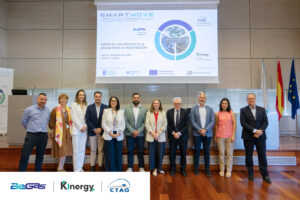

On the occasion of the “Future Mobility Week”, BeGas has organised this event within the framework of the Open Dialogue of the Ministry of Transport, Mobility and Urban Agenda (MITMA) to present the new R&D&I solutions and the keys to promoting responsible mobility in urban transport.
AutoGas is a solution of today that helps to achieve net zero emissions in urban transport. This has been one of the conclusions of the event ‘Public transport and urban cleaning services: challenges and trends in sustainable urban mobility’, organised by the first company to manufacture 100% Euro VI-D AutoGas engines, BeGas, in collaboration with the Ministry of Transport, Mobility and Urban Agenda (MITMA) on 11 December on the occasion of the ‘Future Mobility Week’.
Of the 17 Sustainable Development Goals that the UN established in the 2030 Agenda, the action of this technology-based and research-based company has an impact on almost half of them: making cities more resilient and sustainable, promoting industrialization in sustainable innovation or guaranteeing sustainable consumption and production methods are some of them.
To continue moving forward in this direction and after having participated in the public consultation for the preparation of the Draft Law on Sustainable Mobility and Transport Financing; BeGas has revealed the keys to promoting responsible mobility in urban transport, with the help of leading experts in the sector such as Repsol, UNVI or Urbaser. To do so, it has had María García de la Fuente, president of the Association of Environmental Information Journalists (APIA), as moderator.
During the meeting, the role of alternative energies in sustainable urban mobility has occupied a central part of the debate. Dolores Cárdenas, Repsol’s Advisor on Product Design, highlighted during her speech the importance of maintaining technological neutrality and selecting the most appropriate technology for each use, without ruling out any type of energy that is key in the short-medium term to decarbonise transport.
In her view, “it is necessary to establish clear objectives for air quality and transport decarbonisation without excluding technologies that can be part of the solution in the short, medium and long term, that is, maintaining technological neutrality” since, as she pointed out, “all low-carbon energies for mobility, advanced biofuels, synthetic fuels, hydrogen and electricity will be necessary to achieve the objectives of climate neutrality”.
Precisely AutoGas is the most widely used alternative fuel in the world, offering the same performance as traditional fuels and, in addition, effectively contributing to improving the air quality of cities. The reduction in polluting gas emissions that it achieves makes it an ecological and clean fuel, which provides the transport sector with a perfect solution for urban bus fleets and cleaning services.
The future of sustainable mobility, as the engineering director of the Industrial Vehicle Unit (UNVI), Eva Legido, has maintained, involves “promoting the use of public transport, investing in technological progress and selecting the appropriate technology for each application”. Legido has pointed out “the importance of the ‘well to wheel’ analysis, with AutoGas being one of the solutions that she believes the European Union should take into account”, as it is one of the innovations that exist around sustainable urban mobility.
For Alfredo Sánchez, responsible for sustainability at the General Directorate of Land Transport of the Ministry of Transport, Mobility and Urban Agenda (MITMA), promoting sustainable mobility from institutions is key. To do this, “it is necessary to build a joint strategy between all the actors and carry out the different actions to promote change in the medium-long term and thus achieve the international objectives and commitments,” he said.
Both city councils, public transport and cleaning and environmental care companies, as well as companies in the automotive sector must adapt to the new sustainability demands: adopting cleaner energies, seeking cost efficiency and developing responsible consumption through innovative solutions.
Technologies, key to adapting to the new requirements of sustainable urban mobility
The technological and innovative development that is being used to adapt urban vehicles to the new requirements of sustainable urban mobility has also had a prominent place in this round table organised by BeGas, adopting a triple perspective: environmental sustainability (emission reduction), economic sustainability (administrative efficiency) and social sustainability (citizen awareness).
In this regard, Josep Compte Morales, head of machinery at Urbaser, a company specialising in environmental management with activities focused on urban services, has stressed “the importance of applying the best technology for public transport and urban cleaning services at all times”. In fact, in his speech he pointed out that AutoGas has a better recharging infrastructure compared to other alternative energies. “This is very important for us because of the flexibility it allows us, since the installation is much cheaper”.
He also stressed the importance of looking beyond the market to find all the technical elements, that the public sector gets involved in transport R&D&I projects and the need to incorporate the most cutting-edge technology through collaborations, such as the one he has with BeGas at this time. And the fact is that, “the implementation of AutoGas engines to reduce all possible emissions in extra-urban areas where there are not all the components to achieve clean energy, such as an infrastructure for electric or natural gas vehicles, is essential to reduce emissions.”
Precisely, the new BeGas engines, powered 100% by Euro VI-D liquid injection AutoGas and intended to move urban buses and trucks, with lower CO2 emissions than the most modern diesels, are one of the key solutions to achieve sustainable urban transport.
For Pedro Silva, CEO of BeGas, AutoGas “is an accelerating technology because it is an energy that allows cities to have clean vehicles immediately; transformative because BeGas is the only manufacturer of AutoGas engines in Spain, which is committed to reindustrialisation and the environment; and transitory because this technology allows us to meet the European Union’s requirements regarding noise and polluting gases in the short term.” In fact, BeGas AVG engines drastically reduce pollutant emissions, specifically 51% in CO levels, 22% in PN levels, 57% in NOx levels, 29% in PM10 levels and 87% in HC levels. “That is why we have developed the AVG engine that has achieved Euro VI-D approval.
Technological innovations such as this potentially trigger the actions that can be taken to commit to sustainable urban transport. A social and governmental challenge that must be faced by seeking a global solution.
Under this premise, the conclusions of the event will be sent to the Ministry for consideration in preparing the Safe, Sustainable and Connected Mobility Strategy 2030 and the Draft Law on Sustainable Mobility and Transport Financing.