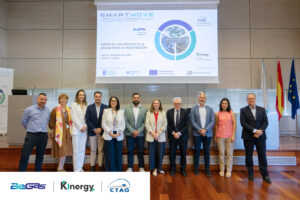

- Clean fuels, fleet recycling and the revitalization of transport are among the challenges facing local entities in sustainable mobility.
- These challenges mark the lines of action that local administrations must take into account to achieve the decarbonisation of urban transport and achieve more habitable cities.
- Experts at BeGas, manufacturers of ecological engines for heavy vehicles, are developing alternatives so that both municipalities and companies can adapt to the 2050 objective, established by the EU, in an efficient and economical way.
The challenge of sustainable mobility also exists for small municipalities. Achieving climate neutrality at a global level is the objective that the European Union has set for 2050, in which all types of corporations must collaborate. This will mean the evolution towards a carbon-neutral economic model based on reducing dependence on fossil fuels, especially in the transport sector.
Without a doubt, it will be a change that must be made gradually, replacing polluting energies with renewable ones. We must not forget that, as established by the United Nations, cities are currently the main cause of carbon emissions, representing 75% of the total on a global scale. Data such as this, highlight the need to adopt new solutions in vehicle fleets, whether for urban passenger transport or for the delivery of goods.
However, this is not the only challenge that local entities face when it comes to decarbonising transport and promoting sustainable mobility without making a large financial outlay. Among the various options for evolving in these terms, and with the aim of being part of the solution, the experts at BeGas, a pioneering company in manufacturing 100% autogas or biopropane engines, establish the main challenges that local corporations will have to face in the coming years:
Streamlining urban mobility logistics
One of the keys to achieving this is to introduce these new solutions in urban planning and logistics in city centres, taking into account the costs involved. This must take into account not only the renewal of vehicles in the urban transport system, but also the infrastructures that are necessary for their maintenance and operation. One of the main problems is found in the charging infrastructures, since options such as electric vehicles imply a national implementation of chargers, which is difficult to achieve in the short and medium term. This is where vehicles powered by clean fuels such as autogas or biopropane are more competent. The reason is found in the services offered by companies such as BeGas, which, by installing their engines, facilitate the supply points in the facilities of the local administration or private company. In this way, the charging action is streamlined, making it more comfortable and economical. At the same time, fleet management becomes easier, as they offer greater autonomy, recharging times are reduced and the vehicle can be operational for longer.
Innovation, key to new needs
All activities carried out in this regard will help build more habitable cities. To do so, new projects are needed that are capable of meeting constantly evolving environmental and social needs. In the transport sector, one of the trends that the pandemic has accentuated is the growing demand for home deliveries caused by the increase in online commerce. Therefore, last-mile logistics, focused on the management of package transport in the last journey that makes delivery to the final consumer effective, is a booming sector. This is certified by companies such as BeGas, where they are already working on the development of an engine, with a smaller cylinder capacity than its first engine, to incorporate it in lighter commercial vehicles. These new models will facilitate the delivery of goods in cities, with less polluting and quieter vehicles.
Commit to fleet renewal that promotes the circular economy
By 2025, Spain plans to reach 10% of clean trucks and 45% of buses. These percentages imply that, in a relatively short period of time, many local administrations will have to choose to renew their urban transport fleets. In this transition, it is necessary to commit to proposals that, in addition to reducing polluting emissions, take into account essential factors such as the circular economy and recyclability throughout the production chain. Otherwise, the problem will not be addressed with a cross-cutting vision. In this sense, the installation of engines powered by renewable fuels such as biopropane in used vehicles can be a good option to close the circle. Among the companies that provide solutions to this challenge is BeGas, thanks to its service of replacing diesel engines in trucks and urban buses with engines that run 100% on autogas or biopropane.
Adaptation to the new European and national guidelines
In the Recovery, Transformation and Resilience Plan, the Ministry of Transport, together with the Ministry of Ecological Transition and Demographic Challenge, will receive the largest injections of European funds Next Generation EU. Within the lines of action, they intend to promote the implementation of the infrastructure for refuelling clean fuels such as biopropane. The mention of this fuel in future government plans reaffirms its important role in moving towards the goal of decarbonising transport, both in cities and in rural areas. Its clear contribution to the environment and, consequently, to the air quality of cities, can be determining factors to encourage its application in the next steps of institutions in terms of mobility.